North Gisborne has experienced significant flooding in recent years, including severe impacts on 28 February 2023 when an intense localised thunderstorm caused sudden and widespread damage to homes, streets and infrastructure. In response Gisborne District Council is investigating flood resilience improvements to reduce risk to life, protect critical infrastructure and support community resilience and insurability.

The North Gisborne Flood Resilience project focuses on flood risks across the Mangapapa, Matokitoki - Valley Road area and Whataupoko near Central School.

Stage 1 - investigation and findings

This phase is nearing completion and includes updating hydraulic models (last updated in 2014, which show similar patterns), assessing how flooding occurred in February 2023 and other severe weather events, identifying stormwater and overland flow constraints, understanding impacts on properties and infrastructure and assessing potential mitigation options.

The assessment used updated flood modelling, analysis of Cyclone Gabrielle impacts and future climate scenarios to better understand flooding behaviour and risks. Flood risk varies across each neighbourhood - with different flooding mechanisms and constraints identified in Matokitoki, Mangapapa and Whataupoko.

Key information to consider

  • Infrastructure

    Flood resilience infrastructure is complex and costly, so options must be carefully prioritised based on risk reduction, affordability, feasibility and community benefit.

  • Cost - Funding $15m

    Total flood mitigation costs for North Gisborne are estimated at over $100 million.

    Allocation project funding is $15m, including $2m for investigations and concept design.

  • Decisions

    No final decisions have been made on preferred options or future delivery – staff are currently workshopping the prioritisation with the final decision to be made at a Council meeting on 25 June.

  • Considerations

    Funding availability, staging and affordability will be important considerations in determining next steps.

    Mitigation options not funded through this project will be promoted for inclusion in the Long Term Plan or Infrastructure Strategy, which set out priorities and direction over the next 10 and 30 years.

Findings and solutions by catchment area

Investigations confirm that flood risk issues in North Gisborne are primarily due to there not being space for floodwater to pass safely through the urban area.

Matokitoki - Valley Road

Matokitoki - Valley Road

The problem
  • In the Matokitoki - Valley Road focus area, flooding is mainly caused by large volumes of water flowing rapidly from surrounding hill country into low-lying urban areas during heavy rain.
  • The Matokitoki upstream rural catchment is 3 times larger than the urban area, placing pressure on streams, drains and culverts which lack capacity during major events.
Possible solutions include:
  • slowing water upstream
  • upgrading drains and culverts
  • widening sections of waterways to improve flow.

Investigations show these upgrades would reduce flood risk for the greatest number of properties, while upstream debris racks can help prevent blockages.

This area has some of the highest flood risk in North Gisborne, but there's strong potential to reduce impacts.

View more information
  • View the maps below
  • Read the Flood Resilience Report for more details

Analysis of the modelled 100-year ARI design event* helps with understanding the flooding mechanisms that cause problems in the Matokitoki – Valley Road catchment:
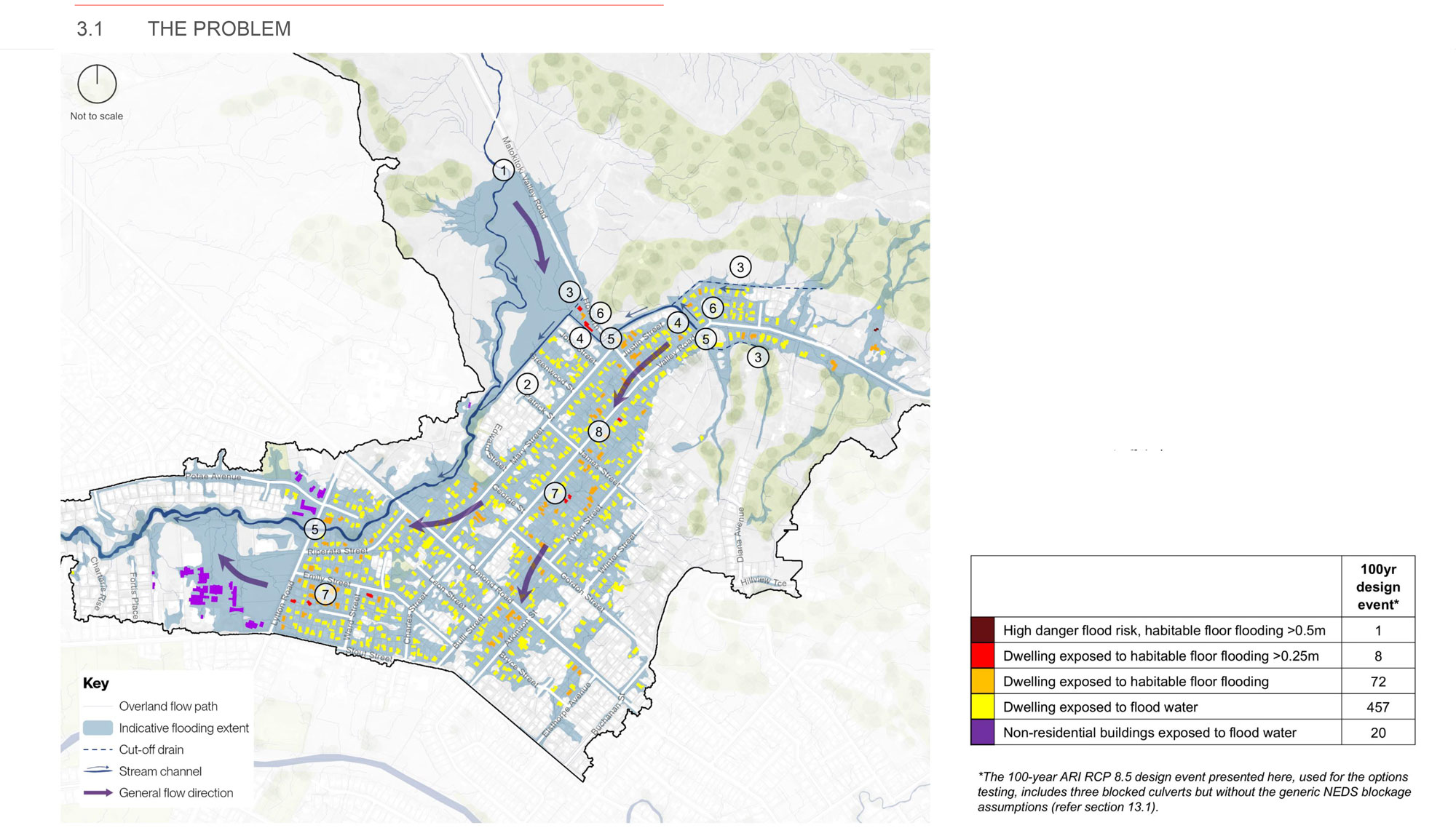
  1. When runoff from the large Matokitoki Stream catchment exceeds stream channel capacity, it contributes significant overland flow down Matokitoki Valley Road.
  2. A bund on the true left bank of the channel works well to contain flows within the channel and protect adjacent properties.
  3. Cut off drains do not have capacity for the high amount of runoff from large upstream rural areas.
  4. Limited channel capacity, particularly where channel is constrained between by residential properties on both sides.
  5. Culverts at risk of blocking and overtopping.
  6. Low-lying properties on the true right of the channel not protected by bunding and at risk of flooding.
  7. Low-lying areas unable to drain as high stream flows prevent the stormwater network from discharging.
  8. Widespread flooding due to large amounts of runoff from rural land not intercepted by cut-off drains or the stream channel and flowing down Howarth Street and Valley Road.

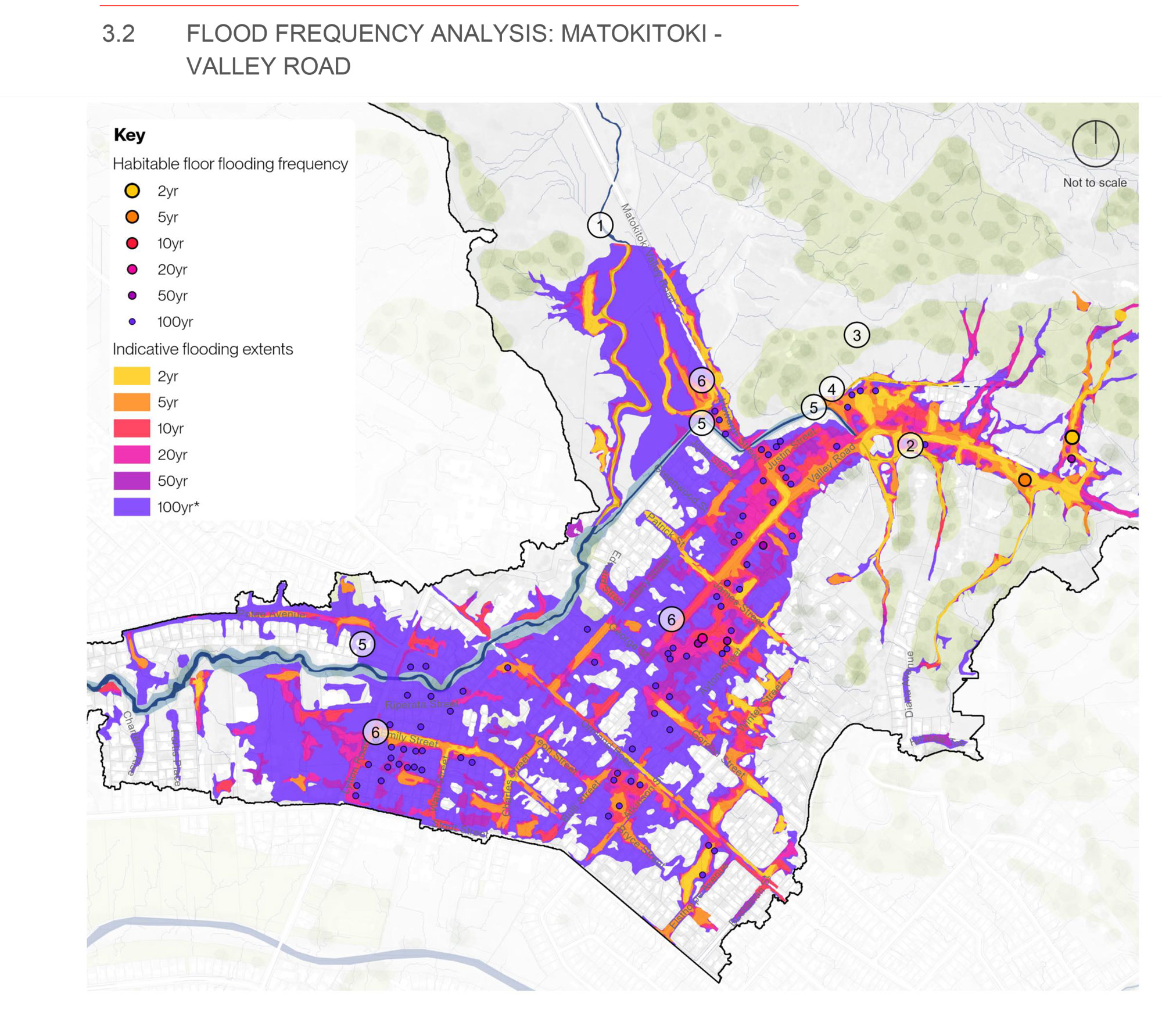
Analysis of a range of different return period events helps to understand how frequently the identified problems (section 2.1) may occur. The coloured dots indicate the smallest/most frequent event where potential habitable floor flooding is predicted. 20-year and 50-year ARI events predict the same number of properties to be effected which is why 50-year ARI dots appear to be ‘missing’ from the figure.

  1. The large Matokitoki Stream catchment only contributes significant overland flow down Matokitoki Valley Road in very large events (100-year ARI) when the catchment is already saturated, triggering significant stream overtopping. Flow is generally intercepted by the cutoff drain/channel before it gets to Valley Road.
  2. Rural catchment gully flow on the south side of Valley Road is not well captured by the cutoff drain and pipe network, spilling into properties in small (2 to 5-year ARI) events.
  3. Rural catchment gully flow on the north side of Valley Road is better managed, being largely intercepted by the cut-off drain up to a 5-year ARI event.
  4. Campbell Street is predicted to flood in as small as a 2-yr ARI event due to undersized and surcharged stormwater pipes. The lack of bund on the true right bank of the channel also means the channel overtops into Campbell Street frequently (5-year ARI).
  5. Culverts at risk of blocking and overtopping. Lytton Road culvert performs well up to a 50-year ARI, assuming there are no blockage issues and the catchment isn’t already saturated, as occurred in the 28th Feb event.
  6. Low-lying areas unable to drain as undersized pipes and elevated stream levels prevent the stormwater network from discharging in events as low as 5-year ARI.
  7. Up to a 10-yr ARI, runoff is largely confined within road corridors. In larger events, runoff from rural land not intercepted by cut-off drains or the stream channel starts to create more widespread flooding that extends into private properties. Extensive flooding across most of the catchment only occurs in the 100-year ARI extreme climate change scenario.

*The 100-year ARI RCP 8.5 design event presented here includes three blocked culverts and the generic NEDS blockage assumptions to understand the full extent of the potential flood risk (refer section 13.1).*

ARI (Annual Return Interval) describes how likely a flood event is — for example, a 100-year ARI event has a 1% chance of happening in any given year.

The proposed solution and associated benefits include:
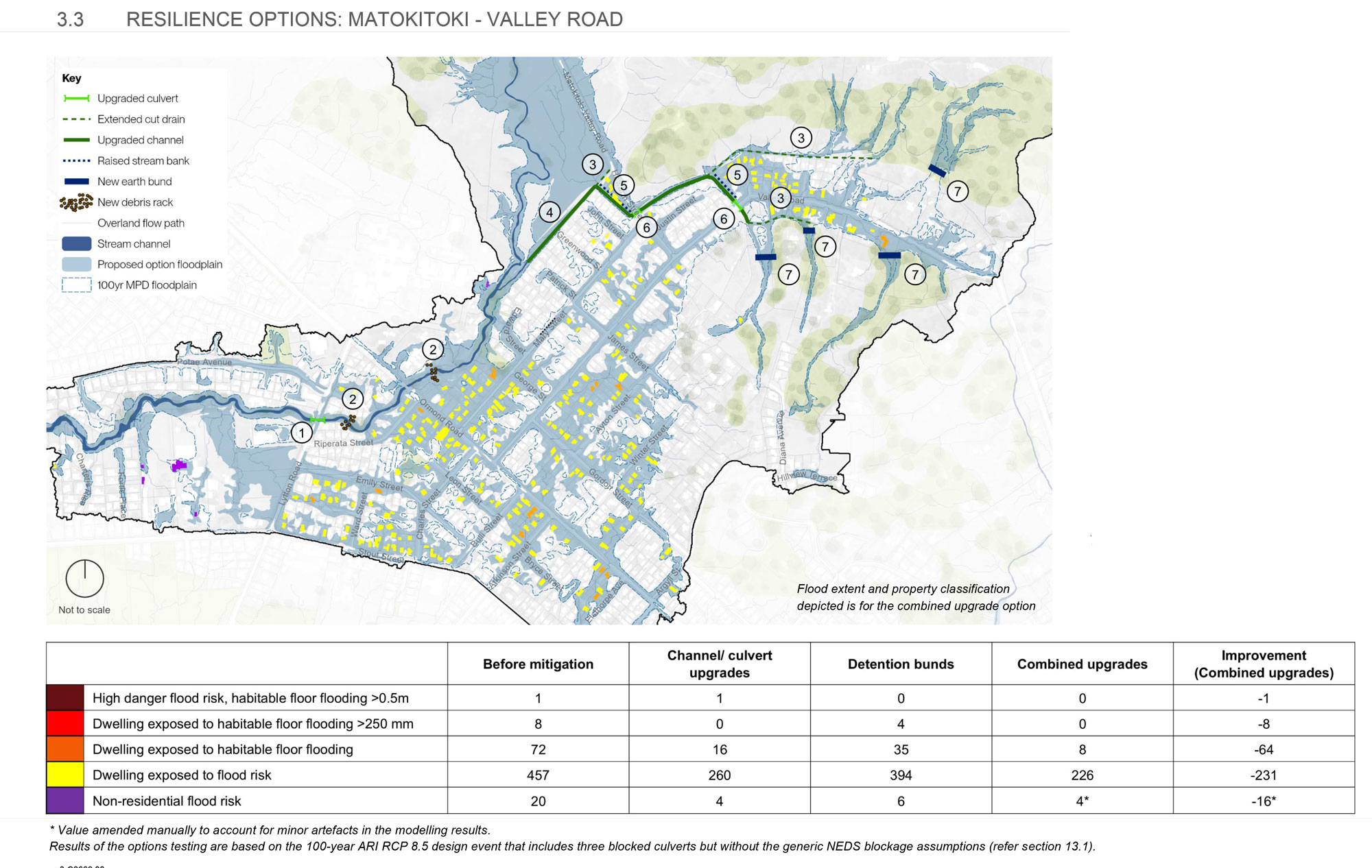
  1. Upgrade the Lytton Road culvert to improve the conveyance of flood flows and reduce the chance of blockage and overtopping.
  2. New debris rack significantly reduces the chance of blockage of the bridge.
  3. Extend and increase capacity of cut-off drains to better intercept upstream rural runoff and direct it into the main channel.
  4. Increase channel capacity from Valley Road to the confluence with the Matokitoki Stream to accommodate the additional flows captured by the cutoff drains. Channel sections constrained by houses on both sides will require some form of bank retaining wall.
  5. Increase the right bank height with a bund to increase the channel capacity and better protect adjacent houses.
  6. Upsize Valley Road and Howarth Street culverts to cope with the additional flows captured by the cutoff drains.
  7. Attenuate upstream rural runoff behind earth bunds.

Flood Resilience Report

North Gisborne flood impacts and resilience options. It includes property impact assessment, options costings and more details.

Mangapapa

Mangapapa

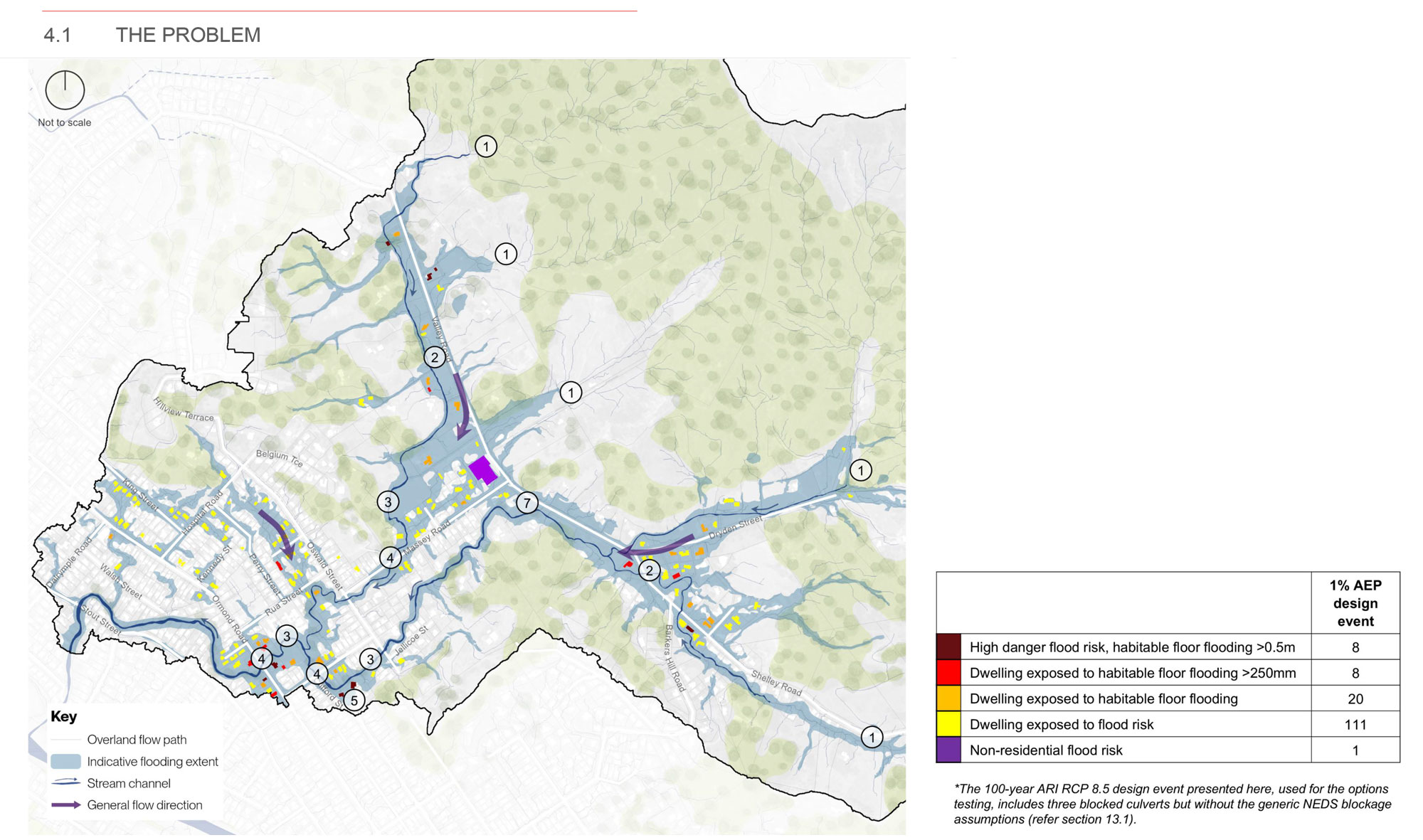
The problem
  • The Mangapapa focus area also has a large upstream rural catchment - similar in size to the urban area.
  • In Mangapapa, the main problem is many homes are located close to streams and low-lying flood-prone areas, making flooding more difficult to manage.
  • Flooding can become worse when streams and culverts are blocked by debris, rubbish or overgrown vegetation during heavy rain.

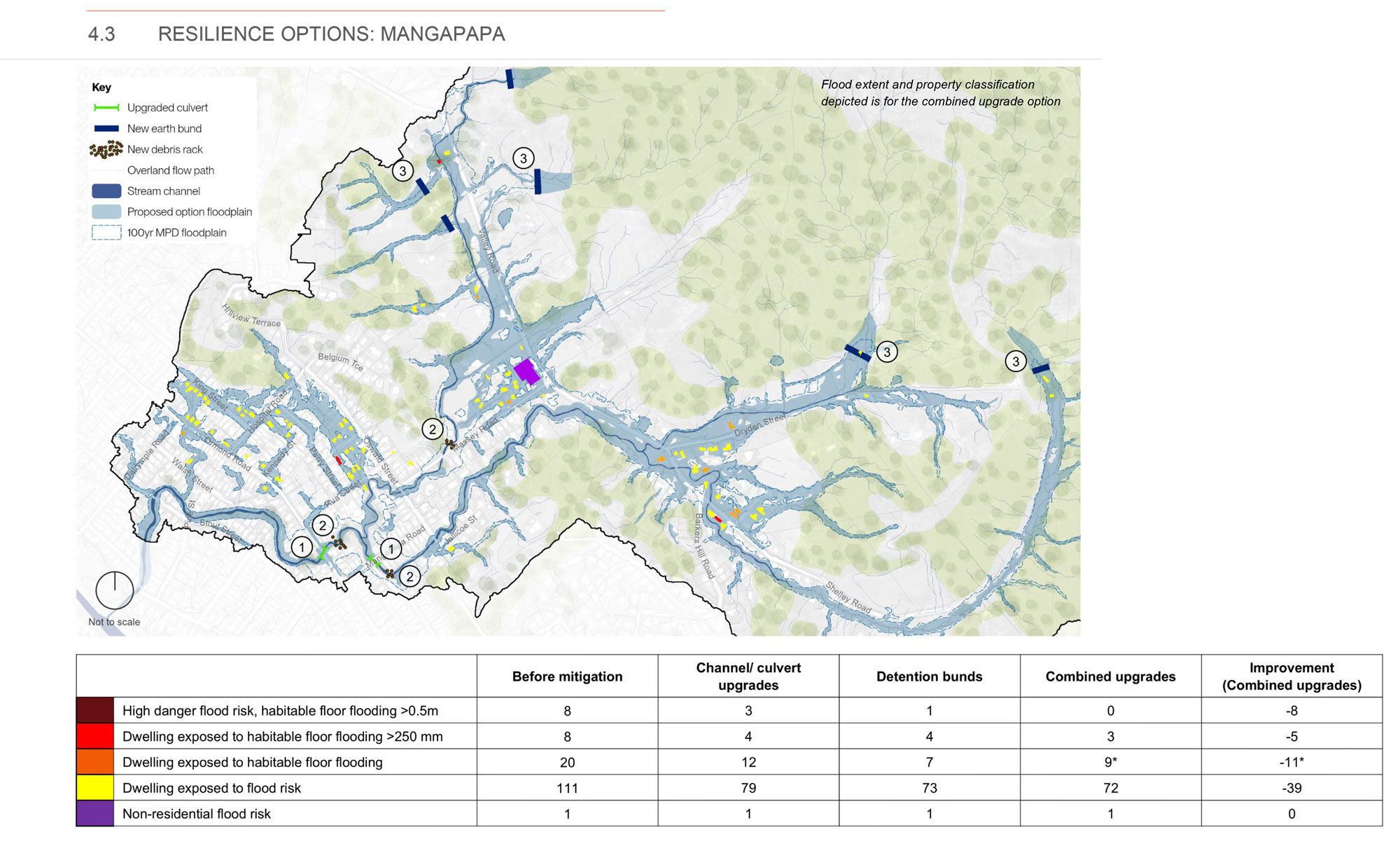
Potential improvements include:
  • using detention bunds to slow water coming from rural areas
  • upgrading culverts to improve water flow and reduce blockages.

Investigations show there are limits to what infrastructure upgrades alone can achieve in this area. Regular maintenance, reducing stream blockages and using a mix of approaches will all be important to help reduce future flood risk in this area.

View more information
  • View the maps below
  • Read the Flood Resilience Report for more details

Analysis of the modelled 1% AEP design event (see section 11.1 in the report) helps with understanding the flooding mechanisms that cause problems in the Mangapapa catchment:

  1. Significant runoff from large upstream rural catchments with no safe path for overland flow when stream capacity is exceeded
  2. Properties built too low in the floodplain and too close to the stream channel, limiting opportunities for channel capacity improvements to reduce flood risk.
  3. High risk of debris in stream channels causing blockage due to heavily vegetated and highly urbanised stream banks.
  4. Culverts prone to blocking and overtopping.
  5. Properties built in low-lying floodplain area close to stream channel.

AEP (Annual Exceedance Probability) describes the likelihood of a flood each year—for example, a 1% AEP event has a 1% chance of occurring in any given year.

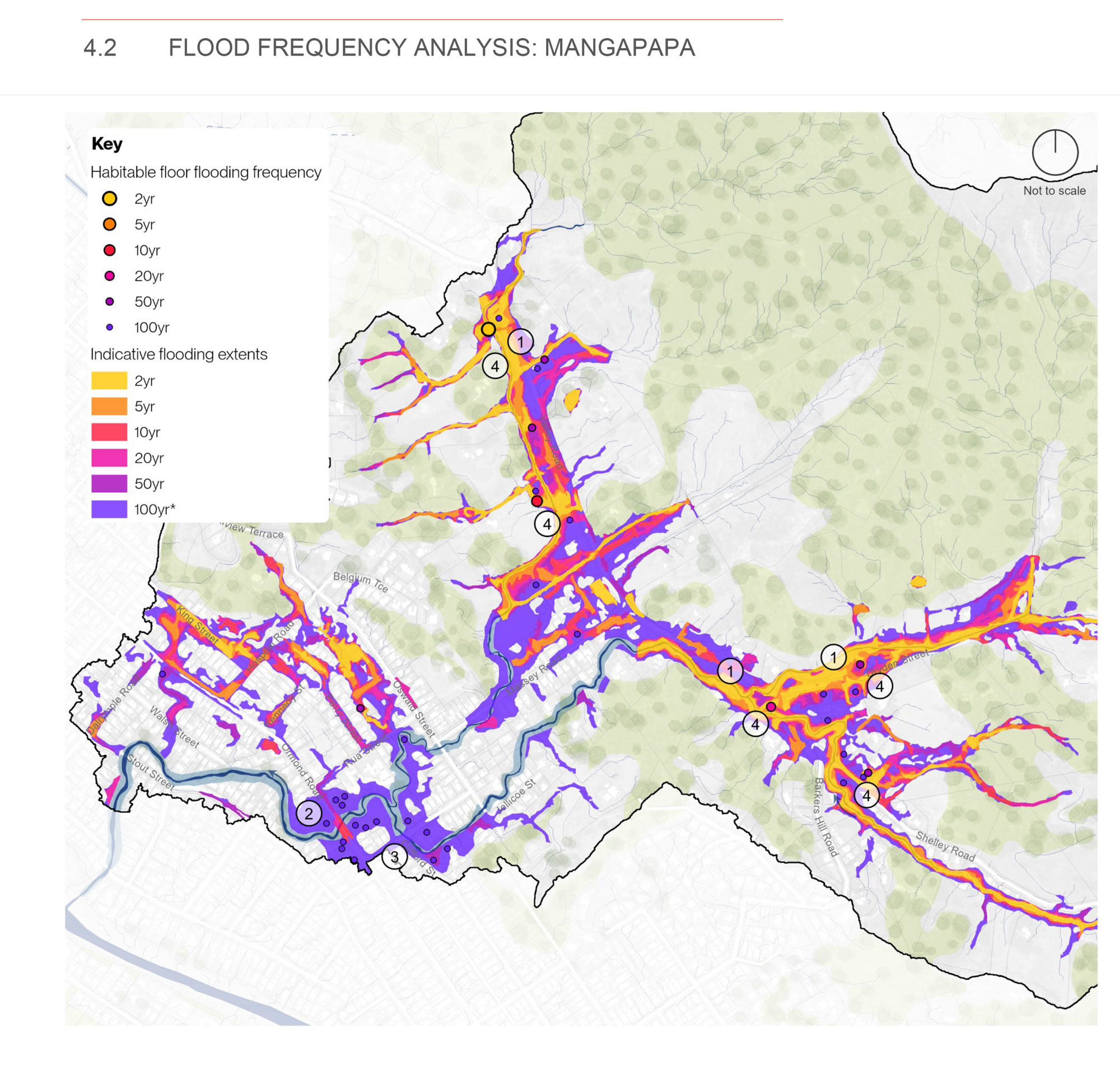
Analysis of a range of different return period events helps to understand how frequently the identified problems (section 3.1) may occur. The coloured dots indicate the smallest/most frequent event where potential habitable floor flooding is predicted. 20-year and 50-year ARI events predict the same number of properties to be effected which is why 50-year ARI dots appear to be ‘missing’ from the figure.

  1. Runoff from large upstream rural catchments is significant, contributing to overtopping culverts and out of bank flow in events as small as 2-year ARI.
  2. Flow is largely confined within the channel of the Mangapapa stream tributaries below Valley Road up to a 20-year ARI, except for the Ormond Road culvert that is predicted to start overtopping in a 10-year ARI event.
  3. The Mangapapa Road culvert may be restricting flows in smaller events (contributing to upstream flooding issues) but requires more than a 50-year ARI before flow will spill over the road.
  4. Properties built in low-lying floodplain area close to stream channel are impacted regularly.

The 100-year ARI RCP 8.5 design event presented here includes three blocked culverts and the generic NEDS blockage assumptions to understand the full extent of the potential flood risk (refer section 13.1 in the Report).

The proposed solution and associated benefits include:
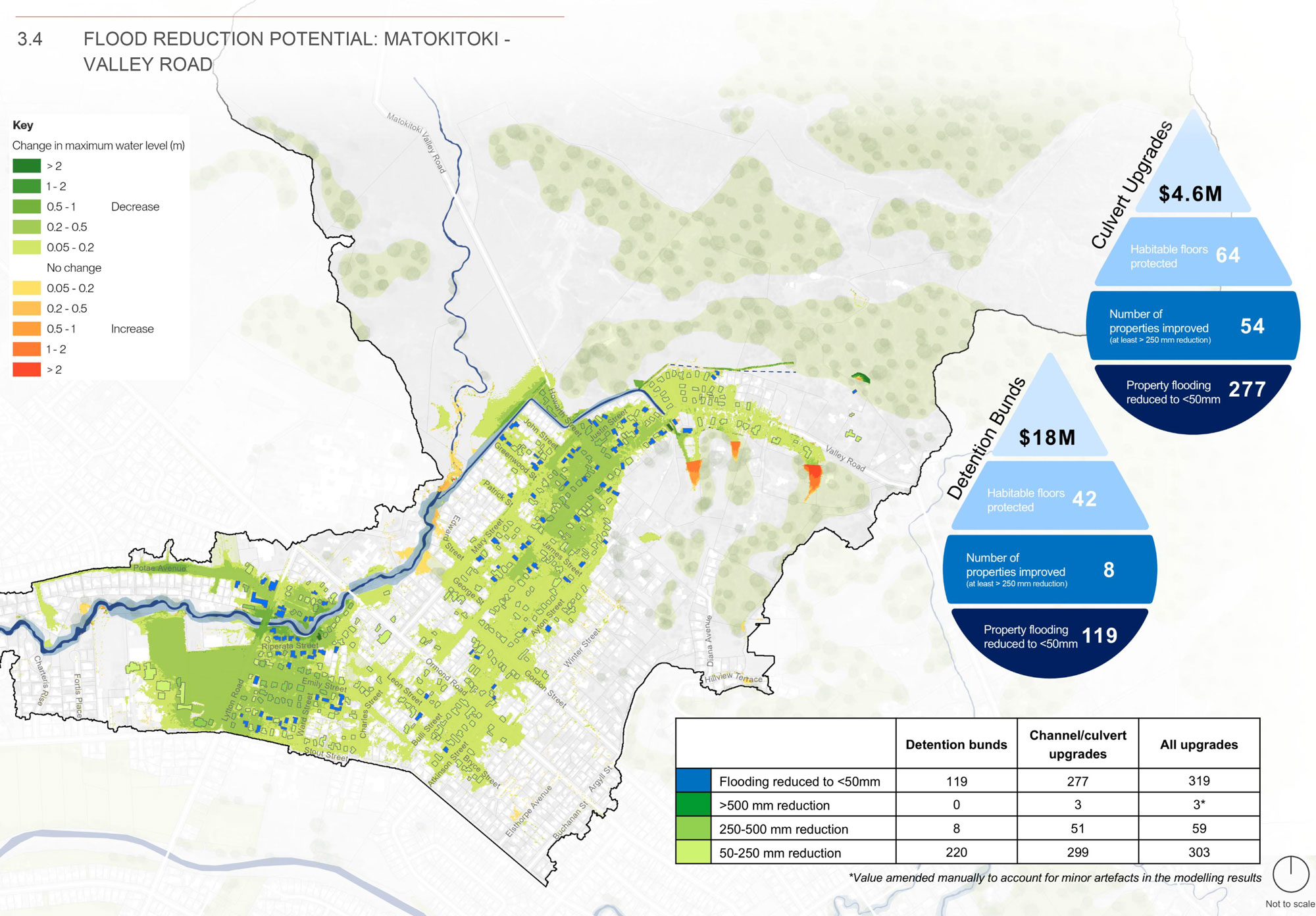
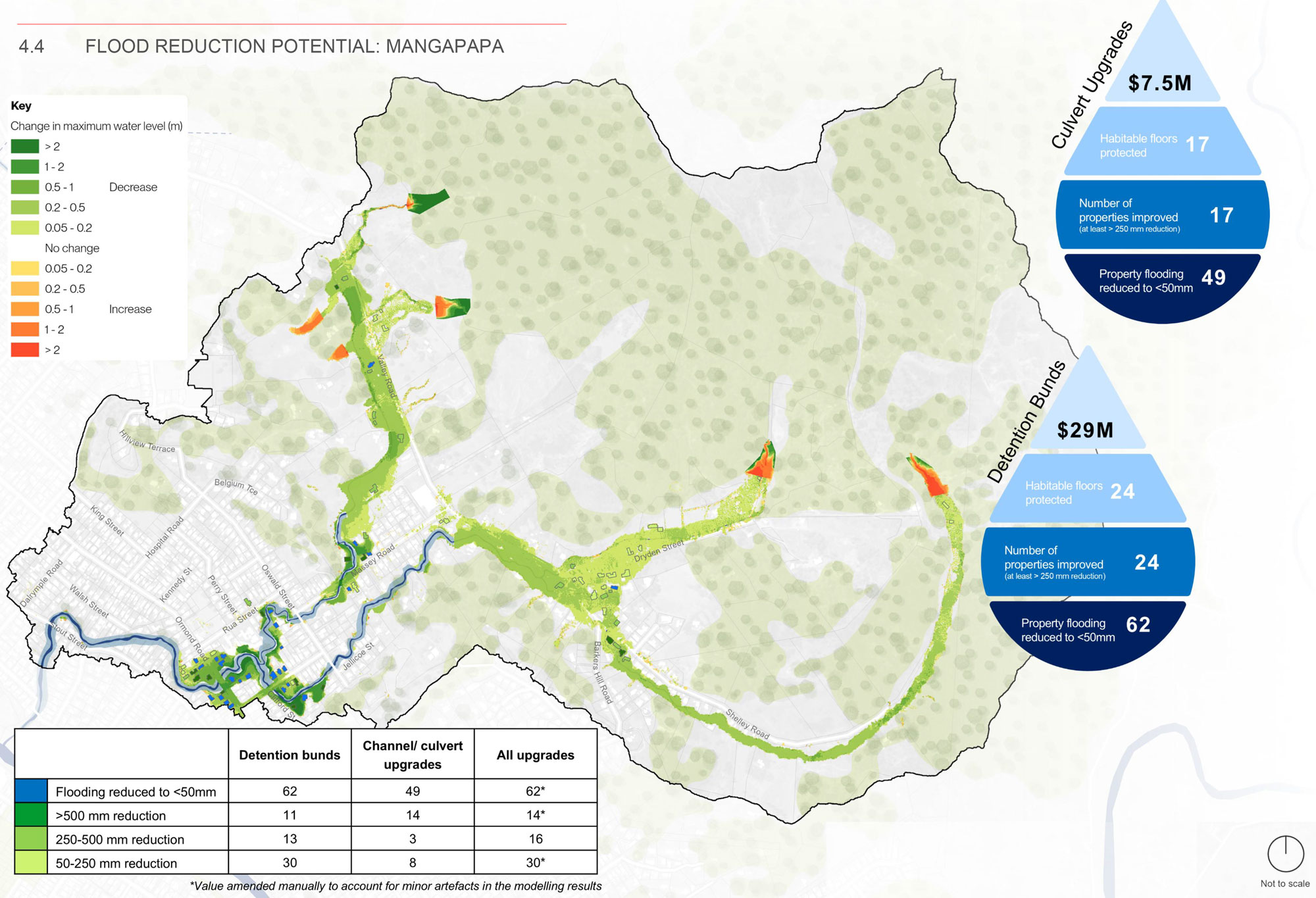
  1. Upgrade the Ormond Road culvert to improve the conveyance of flood flows and reduce the chance of blockage and overtopping.
  2. New debris rack significantly reduces the chance of blockage of the bridge.
  3. Attenuate upstream rural runoff behind earth bunds.

Flood Resilience Report

North Gisborne flood impacts and resilience options. It includes property impact assessment, options costings and more details.

Whataupoko - Central School area

Whataupoko - Central School area

The problem

The Whataupoko-Central School area is low-lying, with many properties built in flood-prone areas and no natural overland flow paths. As a result, the area relies heavily on stormwater pipes and water levels in the nearby stream to manage runoff.

During heavy rain, when this system becomes overwhelmed, water has limited places to go, increasing flood risk to surrounding streets and properties.

Options being explored include
  • upgrading pipes and drains
  • creating temporary water storage areas during heavy rainfall.

Investigations show solutions in this area are complex and costly.

View more information
  • View the maps below
  • Read the Flood Resilience Report for more details
Flooding challenges in the Whataupoko–Central School area

Analysis of modelling shows several key factors contributing to flooding in this catchment:
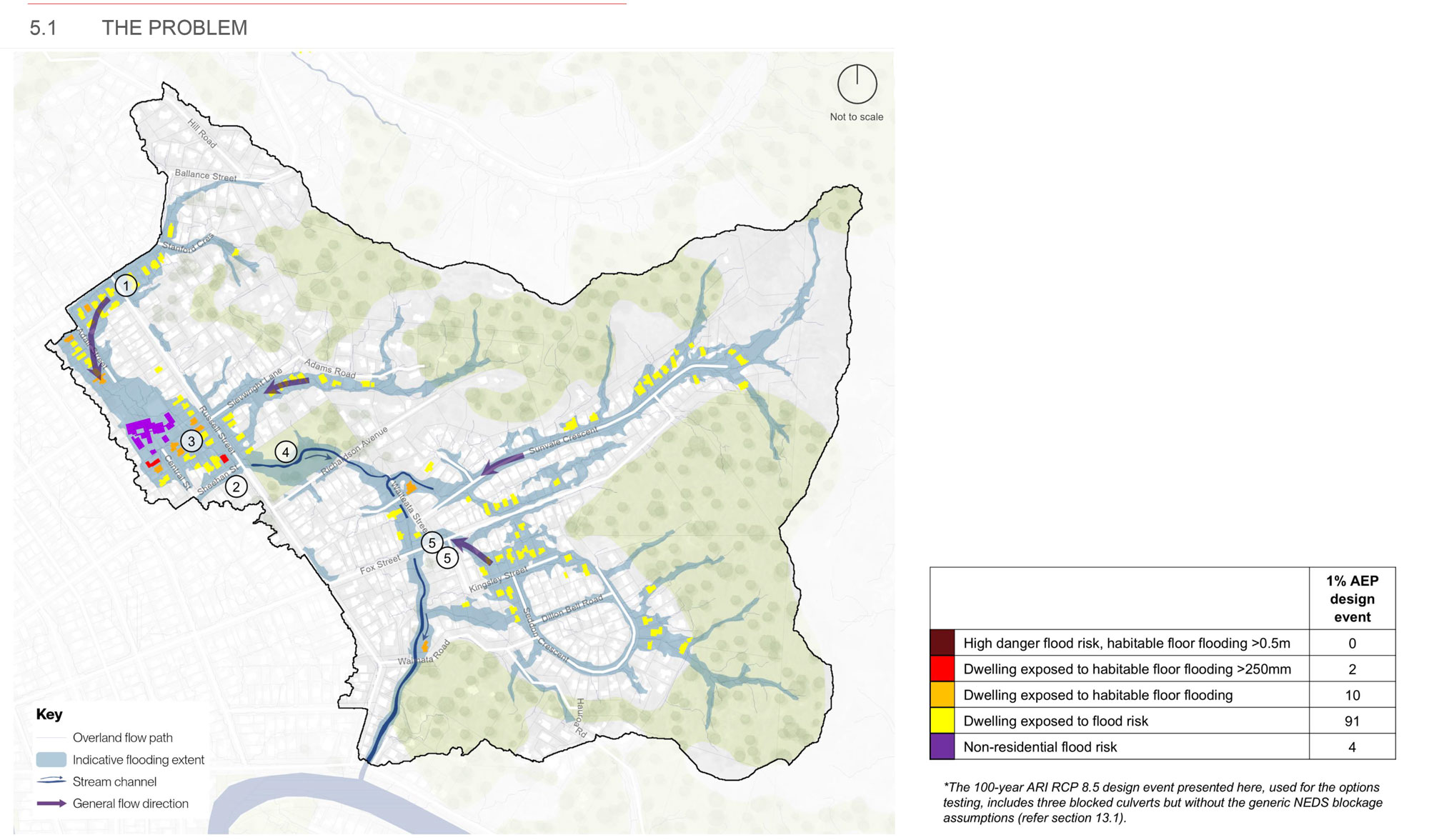
  • Runoff from surrounding areas has no safe overland flow path when the stormwater network is overwhelmed.
  • Roads can block natural overland flow paths.
  • Central School and nearby properties are located in a low-lying area with no overland flow path and limited stormwater capacity.
  • High water levels in the stream reduce the ability of stormwater pipes to discharge.
  • Piped sections of the stream and undersized culverts keep water levels high.

Analysis of a range of different storm events helps to understand how frequently the identified problems (section 4.1) may occur.

The coloured dots indicate the smallest (most frequent) event where potential habitable floor flooding is predicted.

In some cases, 20-year and 50-year events predict the same number of properties to be affected, which is why 50-year results dots appear to be missing from the figure.
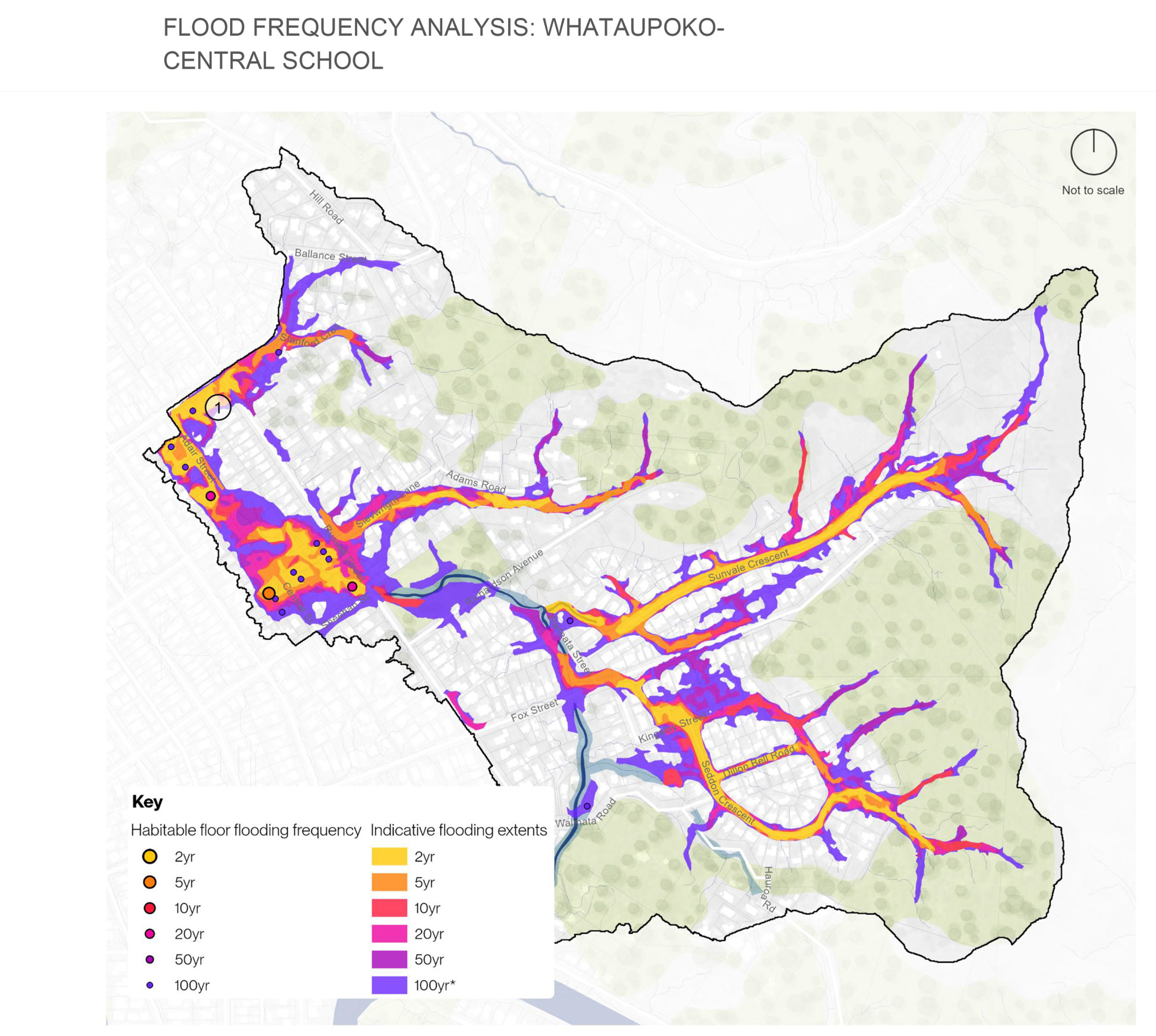
  • Properties in low-lying areas below road level rely on stormwater pipes to drain runoff. With inadequate and undersized pipes, property flooding can occur frequently (for example, during 2-5 yearly events). These areas are also extremely sensitive to the impacts of pipe/inlet blockages.
  • There are a few floor levels impacted (1-3) in events up to 50-year storm, but this number jumps up to 17 properties in a 100-year extreme climate change scenario.

The 100-year ARI RCP 8.5 design event presented here includes 3 blocked culverts and the generic NEDS blockage assumptions to understand the full extent of the potential flood risk (refer section 13.1)

Definitions

ARI (Annual Return Interval) describes how often a flood event is likely to occur on average - for example, a 100-year ARI event has about a 1% chance each year.
RCP 8.5 is a high climate change scenario used to model how flooding could be worse in the future due to more intense rainfall.


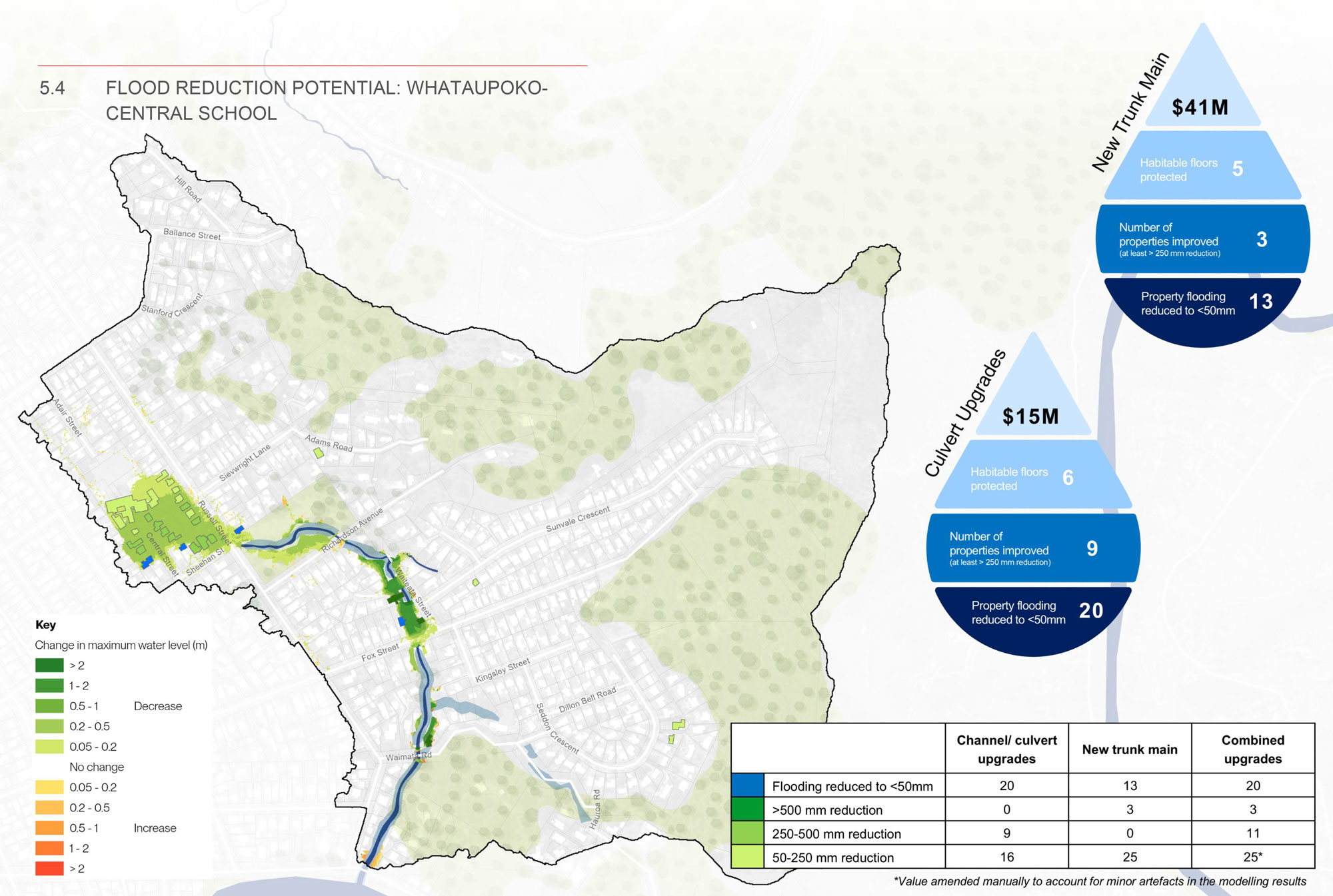
The proposed solution options and associated benefits include:
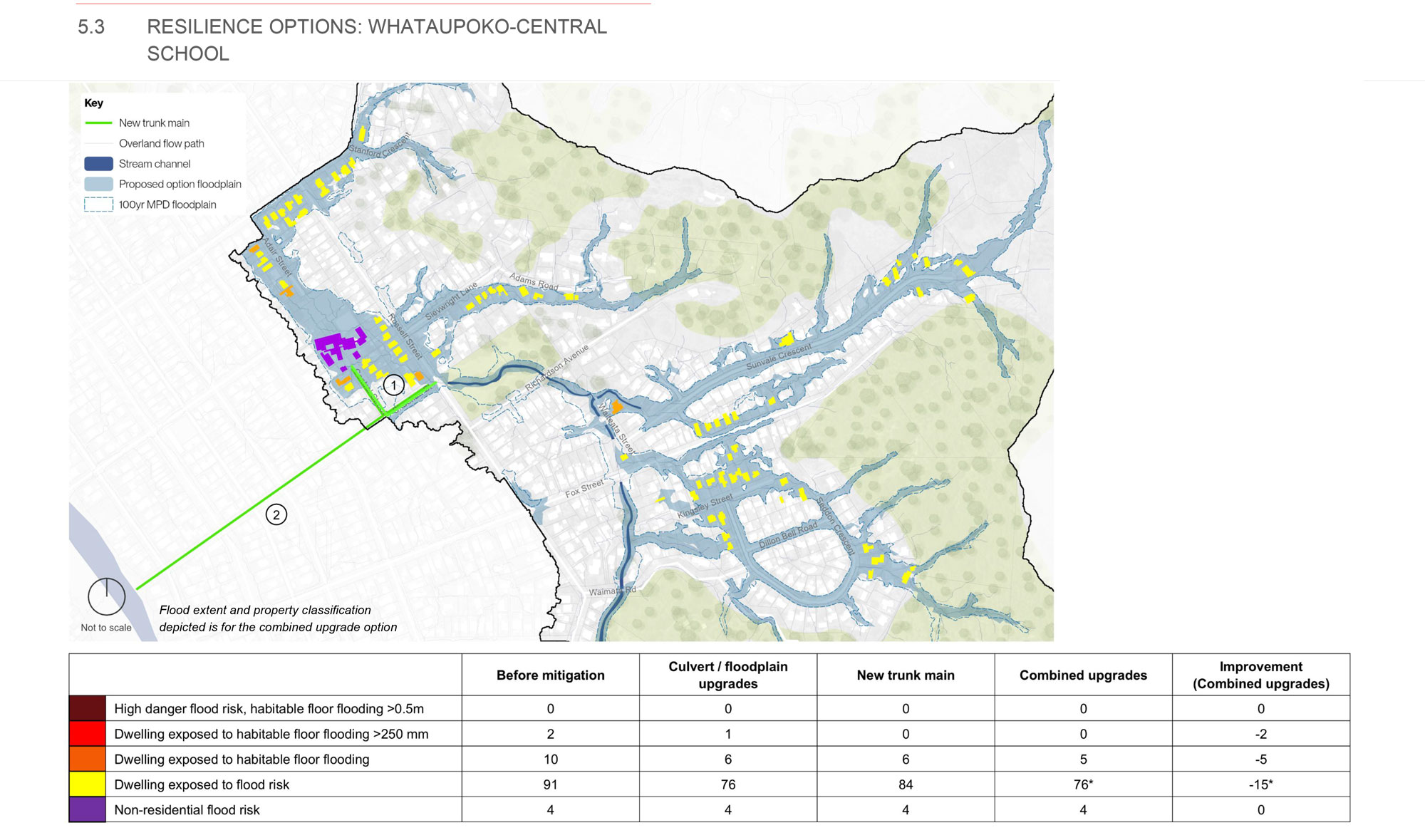
  1. New collection pipes and increased inlet capacity to help drain low-lying area around Central School.
  2. New trunk main down Sheehan Street to the river to help drain the low-lying area around Central School and improve the conveyance of flood flows.

Flood Resilience Report

North Gisborne flood impacts and resilience options. It includes property impact assessment, options costings and more details.

Have your say

We're keen to hear from residents, property owners and anyone affected or interested about the findings and proposed resilience improvements options.

Ask a question and our team will respond, or share your feedback, suggestions and photos by pinpointing a location on the map below.

You can also tell us if you're interested in a community session by completing the poll before Wednesday 17 June.

Provide a short summary of your question.

You have 150 characters left

Provide detailed information relating to your question.

You have 500 characters left

Select a category from the list that best fits your question.

Select a respondent from the list that you would most like to answer your question.

Moderation Policy

These are the people that are listening and responding to your questions.

Flood project team

{{ question.username }} asked

{{question.description}}

{{ answer.respondent.name }}
| Edited

Answer this question

Select the respondent who will be marked as answering the question

Provide the answer to the question. Answer can be saved as draft and published when complete.

No questions found

Contact Us

Have questions or want to learn more about a project, contact us below:

Contact Information
Phone 0800 653 800 (24 hours)
Email service@gdc.govt.nz
Website www.gdc.govt.nz
In writing

15 Fitzherbert Street
Gisborne. 4010
New Zealand