We're proposing changes to the Tairāwhiti Resource Management Plan (TRMP) to make it easier to build homes in Gisborne city.
Proposed Urban Plan Change 6 will update the planning rules to enable a wider range of housing types, supporting increased supply, improving affordability, meeting national requirements and protecting our fertile soils.
Submission period closed
The submission period for Proposed Urban Plan Change 6 has now ended.
*Please note submissions will become available on the 'what people said' tab as they are processed.
The next step in the plan change process is for Council to compile a summary of the decisions requested in the submissions received. This summary will be available to view through the submission portal.
The plan change will open for further submissions in July 2026. Further submissions allow people to support or oppose an original submission on a proposed plan change — this is not a second opportunity to make a new submission.
About Proposed Urban Plan Change 6
What will those rules be?
The goal is to have well‑designed, sustainable, attractive housing developments that build a sense of community, while using land efficiently to protect our productive land for future generations.
The rules for the proposed new Medium Density Residential zone enable more houses on smaller lots, without the need for resource consent. This does not mean that housing developments do not have to meet standards like minimum setbacks, daylight planes, or height limits, amongst others, however in this zone these standards are more permissive than are presently required in the existing General Residential zone that presently covers most of the Gisborne City residential areas.
In addition to the proposed Medium Density Residential zone, the new City General Residential, Mixed Use, City Centre, Local Centre, Neighborhood Centre, Rural Lifestyle (Back Ormond Road Area), and the Special Purpose Future Urban zones combined enable the number and range of housing types expected to be needed over the next 10-30 years.
Map of proposed zones
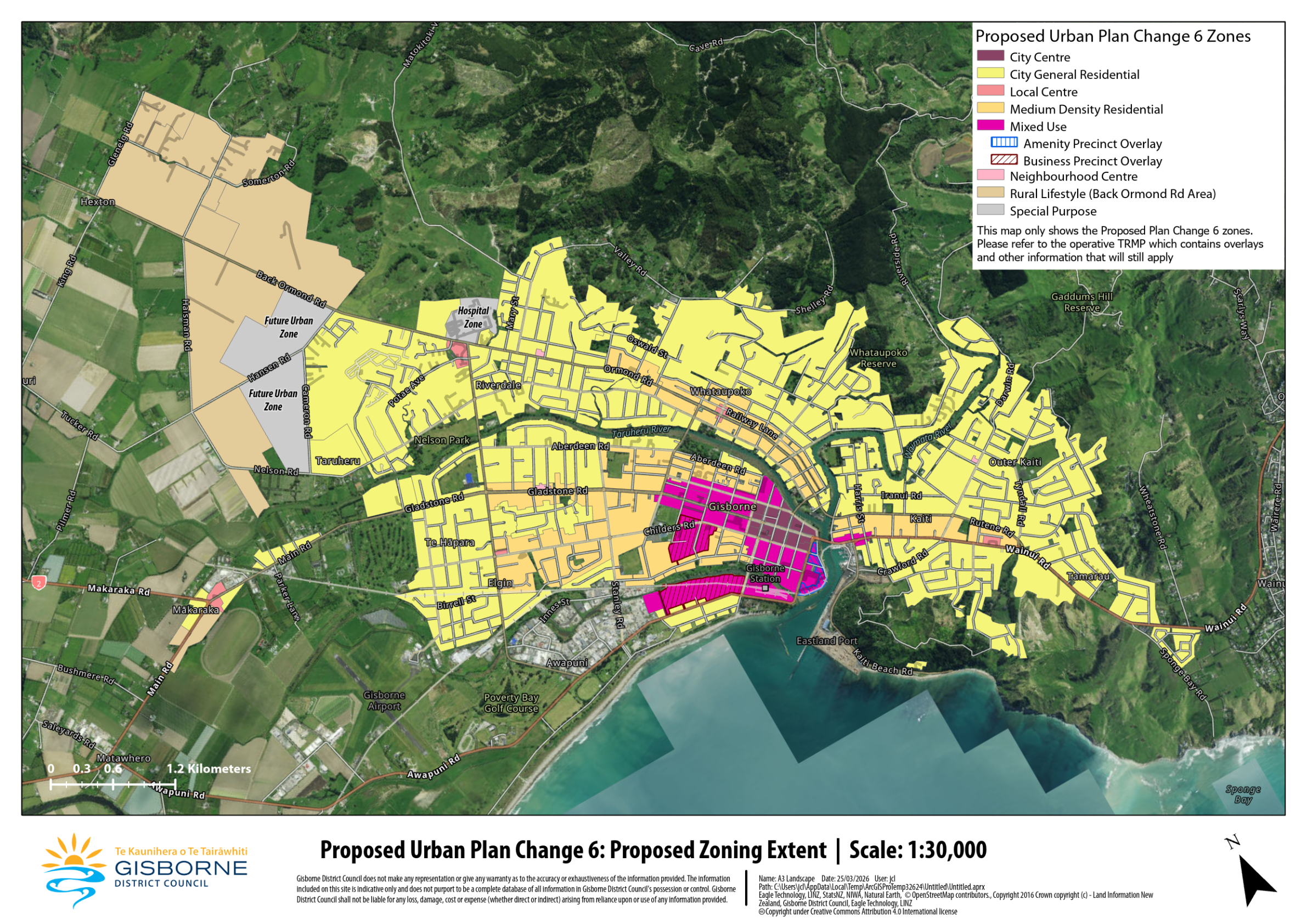
This map only shows the proposed Plan Change 6 zones. Please refer to the operative TRMP which contains overlays and other information that will still apply.
Overview
Proposed Urban Plan Change 6 provides for population growth by enabling a greater range and density of housing types and sizes in the Gisborne City. The Proposed Plan Change does this by rezoning most residential properties in the city and introduces new residential zones that allow a wider range of housing types.
Why is Council making these changes?
Gisborne City is growing. More whānau are looking for homes and housing is already tight. At the same time, we want to protect the fertile soils of Tūranga Poverty Bay Flats, land that supports local jobs, food production and future generations.
To be able to do both, we need to focus on providing more homes within our existing urban areas – known as intensification. Doing that also means we make the most of the infrastructure we have in place, from roads and pipes to access to parks and community facilities like libraries and the City Centre.
Proposed Urban Plan Change 6 will enable development that will change the look of some of the urban areas within Gisborne City.
Urban intensification will potentially affect everyone who lives, works or plays in Gisborne City. However, it will affect those that own or rent a house in Gisborne City in different ways depending on which part of town you live in.
For residents living in the proposed Medium Density Residential zone, this means that should a developer wish to build, for example, low rise (maximum three-storeys) apartments on a section in your area, provided they meet the planning and design rules, you will not be able to object.
It is designed to give people more housing choices on the existing land that's available for housing, while at the same time building connected communities. The plan change enables more one or two-bedroom homes, two and three storey houses or terraced houses and low-rise apartment buildings.
Land use in our region is managed by different zones, each with specific rules that help us identify the nature of the area and what activities may be appropriate, such as business activities, industry or housing. Zoning keeps the city organised, safe and pleasant to live in.
Proposed Urban Plan Change 6 proposes new zones for the Gisborne Urban Area to address the housing shortage in Gisborne City.
Proposed Urban Plan Change 6 proposed the addition of nine new zones within the Gisborne urban area.
These are:
- New City General Residential and Medium Density Residential zones to replace the existing General and Inner City Residential zones within the Gisborne urban area;
- A new Residential Urban Design Guide as an appendix to the TRMP;
- Three new Centre zones, with the City Centre zone replacing the Inner Commercial zone, and the existing Suburban Commercial zone being replaced by a Local Centre zone, for the large shopping areas, and the Neighbourhood Centre zone for the smaller shopping areas within the Gisborne urban area;
- A new Mixed Use zone to replace the existing Outer, Fringe, and Amenity Commercial zones;
- A new Special Purpose Hospital zone to cover Gisborne Hospital, that is presently zoned General Residential.
- A new Special Purpose Future Urban zone to replace an area just beyond the existing urban boundary on the western edge of Gisborne city, presently zoned Rural Residential; and
- A new Rural Lifestyle (Back Ormond Road Area) zone to replace land presently zoned Rural Residential and Rural Lifestyle, also on the western edge of Gisborne city.
Medium density housing is another term for residential intensification and refers to housing on smaller sites, usually resulting in sections of between 100m2 and 350m2. Housing types that might be considered medium density include townhouses, duplexes (two houses attached), terrace housing (three or more attached houses), and low-rise apartments – apartment buildings that are two or three storeys high.
Please refer to the detailed, proposed vs existing zone map in the submission portal to see the new Medium Density Residential zone.